
Boards and Kits

Support Files

AVR Kits

Projects using Atmel micros and BascomAVR
New projects  in development  Click Here

Users’ Section

Available

If you have any projects that you would like displayed, please send E-mail

Contact

E-mail for more information

Classified Section Items Available

I have a limited number of the GLiPIC pcb and associated parts available for purchasing. Below are the items available.

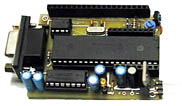
The GLiPIC board designed for KS0108 controller based LCD modules, either the 128x32 or the 128x64 displays. With the adapters available it can also  be used with T6963C and SED1330 controller based LCD displays.Plus, it can be used as a general purpose controller since most pins are  brought to headers. With a bootloader the PIC can be programmed via the serial port.

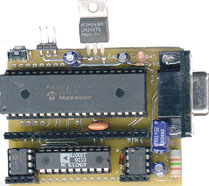
GLiPIC Shown assembled

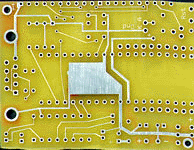
Measures only 1.9 x 2.5”! Double sided board with plated through holes.

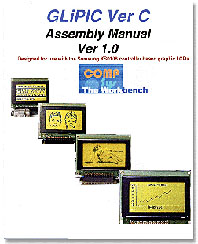
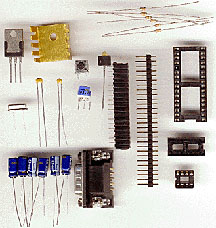
Includes: The GLboard, manual, passive components, connectors, a 20MHz crystal, an LM7805, a PIC 16F877-20, a 24C256 I2C eeprom (can hold up to 32 screens of images!), a MAX232,  and a 128x64 Graphic LCD.

GLboard Rev D

GLBC   --  $19.00

GLiPIC Shown assembled

Parts may vary in size and color

GLKLCD --- $95.00

GLKIT  -Without the LCD -- $50

How to order

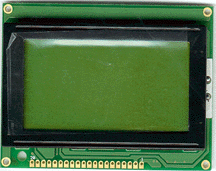
KS0108 controller based LCD module 128x64.

For details on the GLI2 Development board click here

GLI2 Development kit

How to order

SED1330 based LCD 256x128 graphic display and adapter

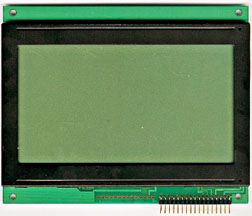
256x128 Graphic LCD with SED1330 controller.

Large display area almost 2.75”H x 5.0”W!

Overall size (pcb area) 4.5”H x 5.75”W. This Hyundai LCD display is not backlit. However, there seems to be provisions for some type of backlight since there is a 2mm gap between the board and the LCD panel. The  SED1330 is a popular controller and has many features. Documentation for the controller is available from numerous sources on the Internet. You can also download it from Epson’s website.

Adapter Kit

GLiPIC Board adapter kit for the 256x128 SED1330 LCD (can also be used with T6963C based LCD’s). Two headers are provided a 1x18 and a 2x10. The unit has an on-board 5v to -15v convertor, a  MAX637, which supplies LCD  negative voltage (Vee). A 20K POT is used for the Vee adjustment. Includes parts shown below.

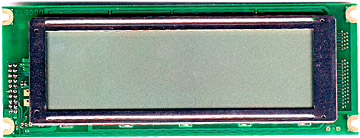
Sanyo 240x64 T6963C based graphic lcd

(no backlight)

Complete Kit GLSEDK $98, includes the GLiPIC kit, the adapter kit and the 256x128 graphic LCD. or Complete Kit GLT69K $98 with the Sanyo 240x64 LCD Save $15 form individual price list.

Adapter shown assembled. 0.9”H x 2.5”W

GLiPIC Shown assembled

Individual Price List*

  • GLADPS2  Adapter kit   $23
  • LCDSED*   256x128 Graphic LCD   $40
  • GLKIT  GLiPIC controller board kit $50

How to order

The GLADPS2 adapter kit

* LCDSED Includes bare GLADPS2 adapter pcb & header pins

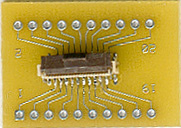
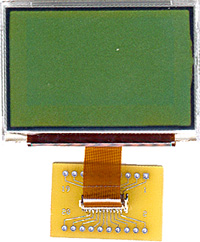
20 Contact Flat Flex Connector & PCB carrier

20 contact connector and carrier pcb for TAB/COG LCDs which have a 0.5mm pitch 20 contact Flat Flex ribbon cable. The carrier can fit in a standard 0.6” wide  20 pin IC socket

20 contact Flat Flex connector and carrier pcb kit. (Requires soldering) COG128 - $10.00

Shown assembled

Right: Shown assembled and connected to a 128x64 Graphic LCD (LCD not supplied)

How to order

Max233A Serial I/O adapter

A tiny serial I/O (TTL to RS232) I/O adapter. Ideal for projects that only occasionally require I/O or in-circuit programming. Eliminates having to place an RS232 transceiver on  every project board. Uses a Max233A IC or equiv. Provided is a DB9 connector for use with a terminal or PC. Signal and power pins connect to your project board via any 4 wire connection, providing +3.3 -  6v, Ground, TTL Rx and TTL Tx.for the AD233A

AD233AK Complete kit $19.00

How to order

AD233AP

Bare PCB

$8.00

Shown assembled

AD233BP

Bare PCB

$9.00

Model AD233BK

Same as the popular AD233AK except that it includes the  pinouts for CTS/RTS handshake signals (via the MAX233). The CTS/RTS pins can be jumpered if handshaking is not required

AD233BK Complete kit $20.00

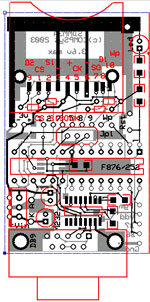
PCB Layout

MMSD3 Kit for MMC as well as SD cards (in non-secure SPI mode)

A complete development board for use with an MMC/SD storage cards. It houses a PIC16F876 mcu, 24CL64 I2C FRAM, Max233 for serial I/O and ISP programming, an LM2937 3.3volt regulator, 10MHz  xtal, power LED and reset switch. Only PortC of the PIC is used, Pins for PortA and PortB are brought to headers for general use. Dimensions: 1.9x2.5  inches

For information on the MMSD3 Kit click here

MMC Complete kit, includes a PIC16F876, Max233 (or ADM233), I2C FRAM, 10Mhz xtal, SD unshielded socket, DB9F connector, reset switch, led, LM2937 regulator and all capacitors and resistors. Supply voltage: 5-12v DC.Does not include a MMC flash card

How to order

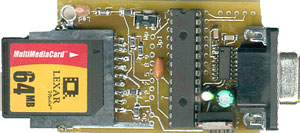
SDMM3X Compact board

Similar to the MMSD3 board but much more compact. It is a PIC based 3.3v development board that is interfaced to a SD/MMC socket. Serial I/O is available via a standard DB8F RS232 connector. The PIC can be loaded with a bootloader so that it can be programmed serially without having to remove it from the board. It also includes a 5 pin header for programming the PIC with a conventional programmer. The SPI lines from the MMC/SD are connected to the hardware SPI pins on the 16F876 / 18F252 PIC as are the serial RS232 lines. It includes a Ramtron 64kbit FRAM, a Max3232 (or equiv.), SD/MMC socket, a 3.3v LDO regulator, a PIC 16F876 or 18F252 and associated passive components.Requires a 7-16v DC supply. PICBasicPro demo code available. PIC program  for a ‘single file’ system on a  FAT16 formatted card also available, which allows the card to be read on a Windows PC card reader. Works with SD as well as MMC cards. Ideal for long term data logging, where the data is received at a slow I/O rate.

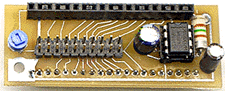
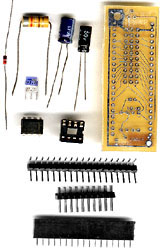
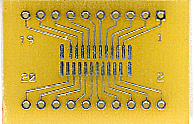
Useful tiny carrier! Use existing DIP8 sockets to try out new SOIC8 devices such as a FRAM to replace a standard eeprom. Available in the parts section ( includes mounting pins )

SOIC8 to DIP Carrier pcb

S8D8P $3.00 (includes pins)

How to order

Shown with a FRAM mounted

Mini Power Supplies

Mini Power Supplies for breadboards 5v, 3.3v and dual voltage modules for quick prototyping and projects. Standard pins easily connects to pcbs and development boards.

PSU5-3 kit $8.00  specify 5v or 3.3v

PSU53PB $4.00

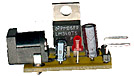
The tiny PSU5-3A provides a 5v dc source using an LM7805 and PSU5-3B provides 3.3v using an LM2937. Includes a power LED. Input 7-15v DC via a 2.1mm power socket.

PSUD kit $18.00

PSU5-3 shown assembled

PSUDPB $8.00

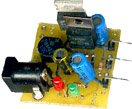
Dual Supply!3.3v as well as 5v supply. This versatile little supply includes a bridge so that 7-15v AC or DC can be used as the source, each output has its own power LED. Standard 2.1mm power socket. Includes an LM7805 and an LM2973

PSUD shown assembled

SOFTWARE

Basic GLiPIC software is available free in the Benchware section.

GLiPIC graphics library* of (GO)Subroutines   GLGLIB -- $23.00

*The GLiPIC graphics library includes routines to draw circles, set/reset a pixel, draw lines, draw rectangles, draw squares, draw diamonds, draw bars, draw an x-y scale with ticks plus more.The  price includes one year of support and any additions or enhancements to the library. Currently available for the KS0108, T6963C controllers only

Bootloader software. With a bootloader one can program the PIC directly via a PC serial port and the GLiPIC serial (DB9) socket. No other programming device is necessary. I  do not provide a bootloader, however, various bootloaders are available from other sources the two that I have tried out are:

The MELoader from MELabs - An excellent bootloader with a Microsoft Windows interface their price includes a PIC 16F877!

PIC Downloader - A free bootloader which also includes a Windows interface. Very  fast and easy to use. Even though it does not explicitly state that it has been tested with MELabs PICBasicPro, I have had no problems loading the GLiPIC hex files with it.

How to order

Return to the top

All Rights Reserved, Copyright (c) COMPSys , 2010

Updated on:

February 10, 2010 

Windows is a registered trademark of Microsoft Corporation. PICMicro is a registered trademark of Microchip Inc.

AVR is a registered trademark of Atmel Corp., MAX is the trademark of Maxim Corporation